
"Not a recognised POD archive" is true of a JPEG, of a POD2 from a later Terminal Reality game, and of a pod whose sectors have been overwritten — and those need completely different responses from whoever is reading the message. So C-POD says which kind of will-not-open it is:
| Verdict | Meaning |
| Too small | smaller than an empty archive's 84-byte header |
| Another format | it opens with some other format's signature |
| Compressed or encrypted | high-entropy all the way through — not a damaged pod |
| Corrupted | mostly unreadable, but with fragments of real data still in it |
| Unrecognised | ordinary data, but the header is not a POD directory |
The last two are the ones worth telling apart, and the signal is simple: damage leaves islands. Compressed or encrypted data is high-entropy essentially everywhere. A corrupted file is high-entropy where it was overwritten and perfectly ordinary where it was not, so sampling across it finds a mixture. For a corrupted pod C-POD reports roughly how much still survives — on one 3.7 MB casualty, 2.5% of it, enough to recognise scenery records naming a model, with the header among the 97.5% that is gone.
That number is worth having because it tells you whether to go looking for a backup, which is the only useful answer when a file is genuinely gone.
A number of track previews in circulation are four bytes shorter than their header claims. C-POD draws them and notes the shortfall rather than refusing.
They are not random damage. Of 6,108 BMPs across an installed set, 29 are short — every one by exactly four bytes, and every one carrying the same header signature. The file declares 255 palette entries and lays out 256, and a BMP palette entry is four bytes: the shortfall exactly, whatever the image's width. They all come from one editor. Of 2,106 track previews at 257×210, the 24 short ones are all from that writer and the other 2,082 are complete at the identical size.
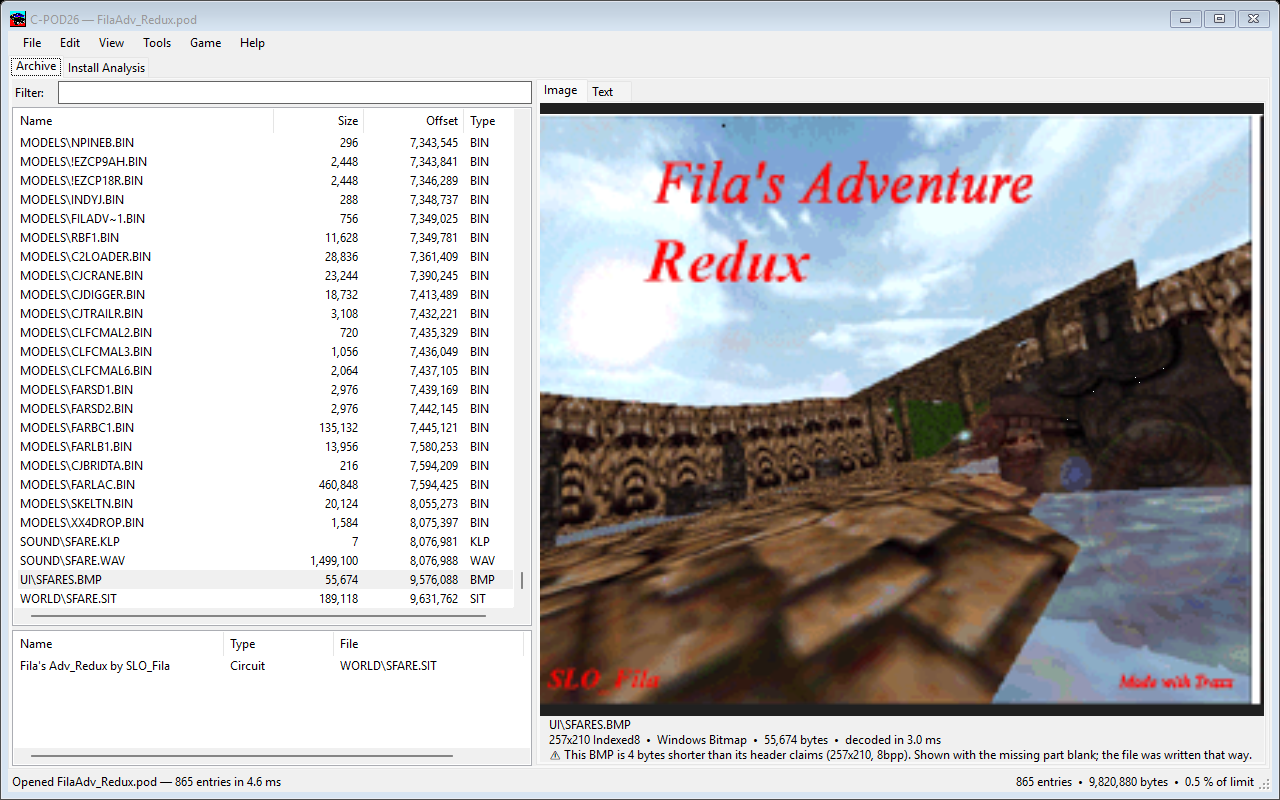
Refusing those would tell an author their file is broken when what is broken is the tool that wrote it — and cost them the preview of art that draws perfectly well.
Filenames containing accented characters survive a save unchanged. This matters more than it sounds: a mangled path no longer names the file the game goes looking for.
It is not hypothetical. A pod compiled by BinEdit 2.3.0 carries a stray
replacement character in its comment; decoding that as plain ASCII turns it into
??? on the way back out — an edit nobody asked for, to a pod
the reader had only opened. C-POD reads and writes those fields byte for byte, so
whatever is in them comes back out the same.
